Recycling and Sustainability — Mill Hill House Clearance
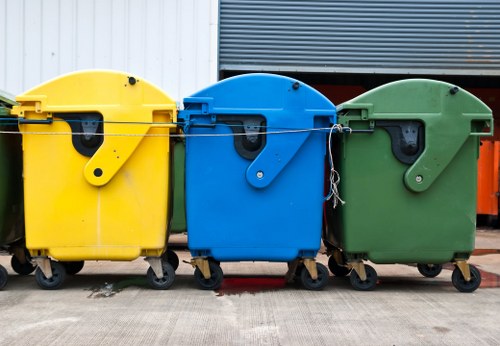 Mill Hill House Clearance is committed to an ambitious, practical and transparent approach to eco-friendly waste disposal. Our house clearance recycling and sustainable rubbish area policies are built to support local boroughs' approaches to waste separation, minimise landfill, and maximise reuse. We balance practical clearance services with a clear environmental agenda: to sort, divert and process materials where they can do the most good. We prioritise reuse and refurbishment before recycling, and we work to ensure every collected item is handled with the lowest possible environmental impact.
Eco-friendly waste disposal area and sustainable rubbish area strategy
Our sustainable rubbish area strategy sets measurable targets and accountable processes for every clearance. We separate waste streams on-site in line with local authority guidance — for example, segregating paper and cardboard, glass, metals, plastics and organic waste where borough rules apply. Mill Hill house clearance teams are trained to follow kerbside-style separation protocols and to record material flows, so we can report progress against our recycling targets with confidence. Our approach reduces cross-contamination and increases the percentage of materials that can be recycled or reused. We maintain active partnerships with local transfer stations and licensed materials recovery facilities (MRFs) to ensure sorted materials are processed promptly and responsibly. We also collaborate with charities and social enterprises to give usable items a second life. Typical partnerships include:
- Furniture and household goods diverted to charity partners for reuse and resale.
- Electronics assessed for refurbishment and routed to specialist e-waste recyclers.
- Textiles sorted and redirected to community projects or accredited recyclers.
Our recycling percentage target is clear and public: we aim to achieve a 70% recycling and reuse rate across all clearances within three years, with interim targets of 60% in year one and 65% in year two. This recycling percentage target is supported by route-level diversion plans and regular audits. Where boroughs have stricter waste separation rules or separate food caddy systems, we adapt our sorting on-site so materials enter the correct local stream, improving overall recovery rates and supporting municipal recycling goals.
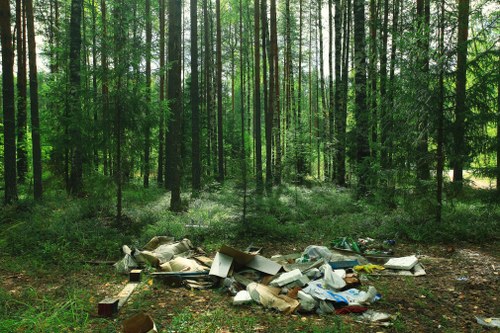
Low-carbon vans and green logistics
Our fleet of low-carbon vans plays a key role in reducing the carbon footprint of each clearance. Mill Hill clearance operations deploy electric and low-emission vehicles where feasible and use route optimisation software to minimise mileage and idling. Drivers use best-practice loading to reduce trips to transfer stations and consolidate deliveries to recycling facilities. Low-carbon vehicle use is measured alongside waste diversion metrics, so the full environmental benefit of each job is tracked and improved over time.We work closely with local transfer stations to ensure transparent processing chains. Materials are tracked from curbside to recovery: items sent to MRFs, specialist recyclers, or charity partners are logged and weighed, enabling us to quantify outcomes. Our sustainable rubbish area procedures emphasise reuse first — functionality testing, basic repairs and safe decontamination are performed where appropriate so that perfectly serviceable items leave a clearance to help others instead of becoming waste.
Accountability and continuous improvement underpin our commitment to sustainable house clearance. We publish internal performance metrics and review progress against the recycling percentage target quarterly. Where possible we pilot new materials recovery techniques and test collaborations with local authorities that encourage more nuanced separation — such as dedicated glass and textile streams or local take-back schemes that some boroughs have introduced. Mill Hill House Clearance takes a pragmatic, evidence-led approach to increasing our recovery rate while maintaining safe, efficient clearances.
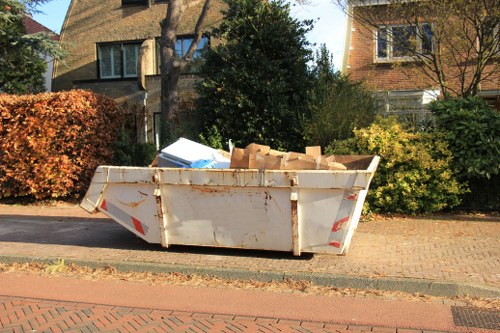 Community partnerships and charity redistribution are central to our model. We collaborate with neighbourhood charities, furniture reuse charities, and electronic refurbishment social enterprises to keep good items in circulation. Reusable goods recovered from clearances are sorted to quality standards, and usable furniture and white goods are channelled to community organisations rather than to disposal. This not only reduces waste but also brings social benefit by supporting local people and projects.
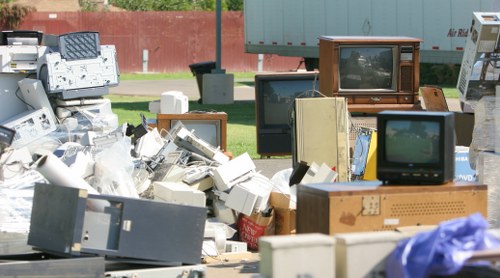 In summary, our sustainable rubbish area and eco-friendly waste disposal commitments combine practical on-site separation, measured recycling percentage targets, local transfer station cooperation, charity partnerships and a low-carbon vehicle fleet. Mill Hill house clearance focuses on diversion, reuse and transparent reporting so that every clearance contributes to a circular, low-waste future. We continually refine our processes to align with borough waste separation schemes and to improve environmental outcomes across the services we provide.